


















Erstens können die grundlegenden Setzlinge, Pflanztiefe, Pflanzenabstand und andere Indikatoren quantitativ eingestellt werden.
The basic seedlings inserted in the Reis-Transplanter are determined by the number of holes (density) inserted per acre and the number of plants per hole. According to the requirements of rice population quality cultivation, planting and seedling reduction, the row spacing of the transplanting machine is fixed at 30cm, and the plant spacing has multiple or stepless adjustments, reaching the planting density of 10,000 to 20,000 holes per mu.
Adjust the lateral moving handle (multi-speed or stepless) and the vertical feeding adjustment handle (multi-speed) to adjust the area of the small block (the number of seedlings per hole) to achieve the appropriate basic seedling requirements, and the depth can also be passed through the handle. Convenient and precise adjustment can fully meet the agronomic technical requirements.
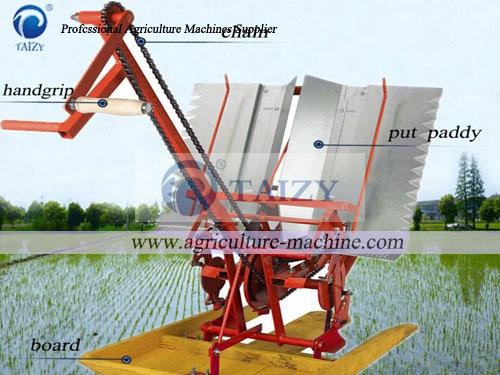
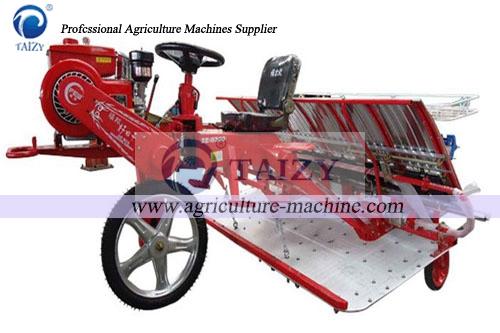
Der zweite besteht darin, ein hydraulisches Profilierungssystem zu haben, um die Stabilität der Reisanbaumaßnahmen zu verbessern.
Er kann den Maschinenzustand kontinuierlich an die Schwankungen der Feldoberfläche und der harten Bodenschicht anpassen, um das Gleichgewicht der Maschine und die Einstecktiefe zu gewährleisten. Gleichzeitig wird die Schiffsscheibe bei unterschiedlichen Bodenarten, hartem oder weichem Boden, mit einem bestimmten Erdungsdruck gehalten, um starkes Schlammableiten zu vermeiden, das die eingesteckten Setzlinge beeinträchtigen könnte.
Drittens ist der Mechatronikgrad hoch und der Betrieb flexibel.
The high-performance Reis-Transplanter has the world’s advanced mechanical technology level, high degree of automation control and mechatronics, which fully guarantees the reliability, adaptability and operational flexibility of the machine. Fourth, the work efficiency is high, saving labor and saving costs. The walking type transplanter has an operating efficiency of up to 4 mu/hour and a ride-type high-speed Reis-Transplanter of 7 mu/hour. Under normal operating conditions, the working efficiency of the walking transplanter is generally 2.5 mu / hour, and the riding high-speed Reis-Transplanter is 5 mu / hour, which is much higher than the efficiency of artificial planting.