


















There are three main types of small rice milling machines in China: separate rice milling machines, Combined rice mill and Spray rice mill.
Getrennte Reismühlenmaschinen
The split rice mill is easy to operate and has a low price, but the model is aging, and the milled rice is poor, and it has gradually been eliminated. Including a feeding device, a rice milling device and a separating rice bran device, the outlet of the feeding device is connected to the inlet of the rice milling device, and the outlet of the rice milling device is connected to the inlet of the separating rice bran device, characterized in that the feeding device The feed port is connected to a moisturizing device for wetting the grain, which is a tubular structure comprising a steam inlet and a grain inlet, and a valve is provided at the steam inlet.
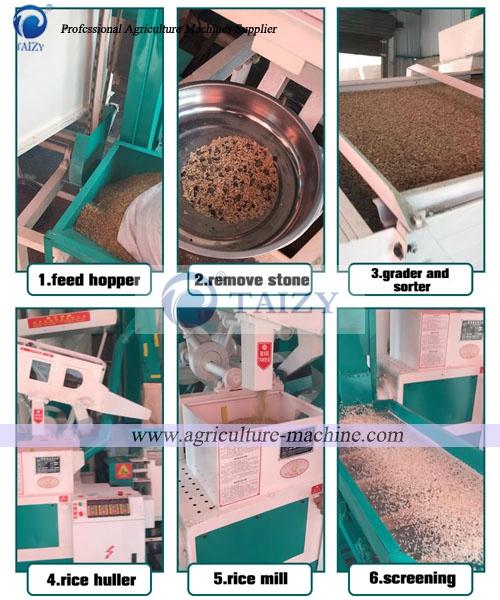
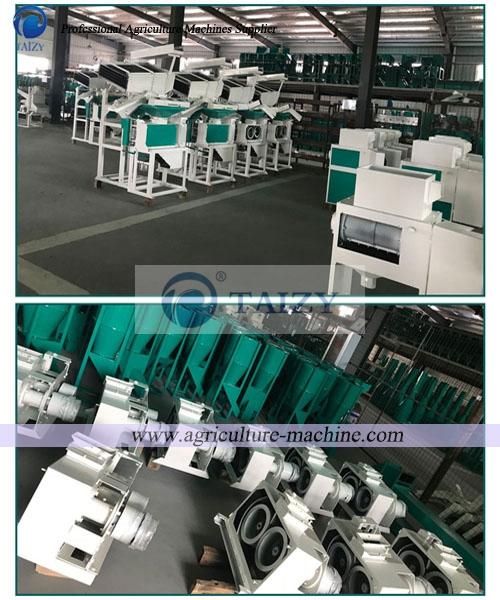
Combined rice mill is a kind of high efficiency rice processing comprehensive equipment, with a compact structure, beautiful shape, simple operation, high rate of rice, broken rice, low power consumption and other advantages, suitable for farms, collective and individual grain processing, processing of rice quality is good, but its structure is complex, the price is more expensive.
Die Sprüh-Reismühle hat ein gutes Kosten-Leistungs-Verhältnis und kann den Schäl- und Weißungsprozess auf einmal abschließen, und der verarbeitete fertige Reis ist weiß und hell, und hat in den letzten Jahren das Hauptprodukt auf dem Markt geworden. Im Vergleich zu den Sprüh- und Split-Reismühlen hat die Serie der Reismühlen große Verbesserungen in Struktur und Leistung, fortschrittliche Struktur, schönes Aussehen, Selbstjustierung, bequeme Bedienung und Wartung (insbesondere beim Wechseln sehr praktisch), mit den Vorteilen hoher Reisschlagrate, guter Reissqualität, großem Output, geringem Geräusch, niedrigem Stromverbrauch und niedriger Reistemperatur.