


















Die Entwicklung des Mais-Schäler-Baus
According to statistics, since the 1980s, China has begun to purchase a batch of advanced Mais-Schäler from abroad. From the hand-operated Mais-Schäler to electric corn thresher, farmers gradually relieve from the heavy manual labor. In the end of 2014, there were more than 240 top agricultural machine manufacturers in China, and they sold more than 350,000 sets, corn sheller, annually. China’s agricultural development constantly tends to be mechanized, and the development and research of it has gradually been put on the agenda and has become the focus of China’s agricultural development.
Von der Geburt des Mais-Schälers bis zur Entwicklung und dann zur Verbreitung ist dies ein Zeichen für die Modernisierung der landwirtschaftlichen Entwicklung Chinas. Aufgrund des weiten Territoriums Chinas, der klimatischen Bedingungen und der agronomischen Anforderungen bergiger Regionen sowie der wirtschaftlichen Gegebenheiten variieren stark. Daher wird der Mais-Schäler sehr umfangreich eingesetzt.
The annual harvest season is a busy time. Many farmers began buying Mais-Schäler in advance, referring to its band, price and the technical parameter.
However, we can’t just look at the appearance to judge the quality of the machine, and the internal fittings are the most important. Thus, good thresher must be practical. Taizy Machinery specializes in agricultural equipment for more than 10 years, regarding designing machines, we consider both aesthetics and practicality. Our corn thresher is not only efficient but also designed with good looking.
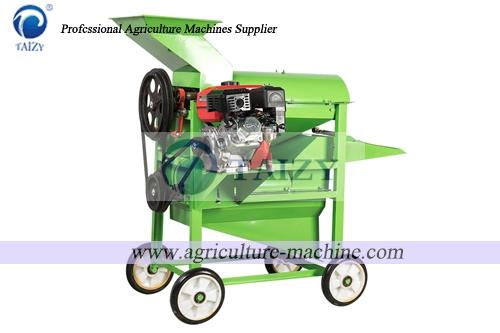
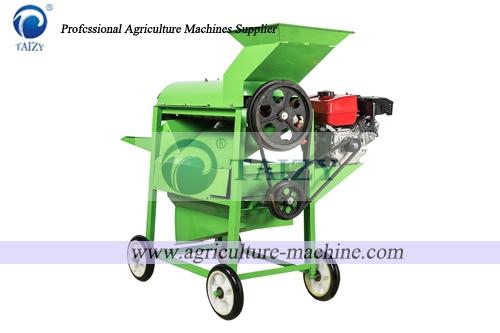
As we all know, machine many occur some problems when operation. The biggest problem is that corn kernels can not be threshed fully. Today I will introduce some common problems and suggestions for you.
1. Einige Maiskörner befinden sich noch auf den Kolben
reason:
(1). operator places too much corns into machine or the it is not uniform to put corn into machine.
(2). The threshing gap between the groove and the concave plate is too large.
(3). The rotation speed of the drum is too low;
(4). The corn is too moist.
Lösung
(1). reduce the amount of feed, even feeding.
(2). Correctly adjust the threshing gap, and replace the worn parts in time.
(3). The pulley of the power Mais-Schäler should match the pulley of the thresher. If the pulley is slippery, adjust the tensioner to tighten the belt.
(4). the straw too wet food should be properly ventilated, dried and then threshed.
2. Die Reinigungsrate der Mais-Schäler ist gering.
Begründung:
(1). Unzureichendes Luftvolumen verursacht Riemenrutschen, wodurch die Ventilator-Geschwindigkeit den Index nicht erreicht.
(2). Die Schraube der Ventilerscheibe ist locker, wodurch Leerlauf entsteht, und der Ventilator kann nicht normal verwendet werden.
(3). Es gibt zu viele Strohreste im Schäldrum.
Lösung:
(1). Prüfen Sie die Riemenspannung des Ventilators; wenn die Spannscheibe zu locker ist, justieren Sie den Spanner ordnungsgemäß und ziehen Sie die Riemenführung auf das geeignete Maß fest; wenn die Befestigungsschraube der Ventilatorscheibe locker ist, ziehen Sie sie fest.
(2). Die Fütterungsmenge reduzieren oder den Fütterungsabstand anpassen.