

















Le développement de la machine à battre le maïs
According to statistics, since the 1980s, China has begun to purchase a batch of advanced moissonneuse à maïs from abroad. From the hand-operated moissonneuse à maïs to electric corn thresher, farmers gradually relieve from the heavy manual labor. In the end of 2014, there were more than 240 top agricultural machine manufacturers in China, and they sold more than 350,000 sets, corn sheller, annually. China’s agricultural development constantly tends to be mechanized, and the development and research of it has gradually been put on the agenda and has become the focus of China’s agricultural development.
Depuis la naissance de la batteuse de maïs jusqu'à son développement puis sa popularisation, c'est un signe de la modernisation du développement agricole de la Chine. En raison du vaste territoire de la Chine, des conditions climatiques et des exigences agronomiques des zones montagneuses ainsi que des conditions économiques varient considérablement. Par conséquent, l'utilisation de la batteuse de maïs est très répandue.
The annual harvest season is a busy time. Many farmers began buying moissonneuse de maïs in advance, referring to its band, price and the technical parameter.
However, we can’t just look at the appearance to judge the quality of the machine, and the internal fittings are the most important. Thus, good thresher must be practical. Taizy Machinery specializes in agricultural equipment for more than 10 years, regarding designing machines, we consider both aesthetics and practicality. Our corn thresher is not only efficient but also designed with good looking.
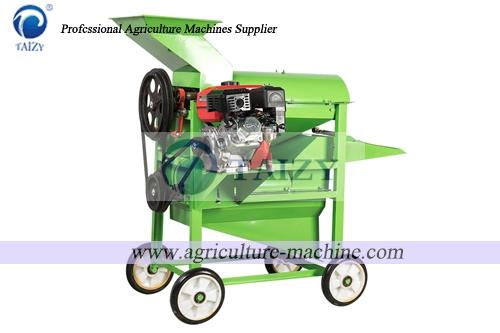
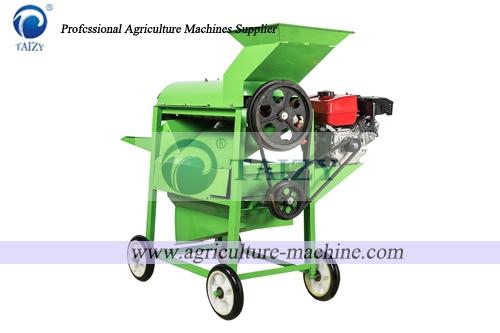
As we all know, machine many occur some problems when operation. The biggest problem is that corn kernels can not be threshed fully. Today I will introduce some common problems and suggestions for you.
1. Certains grains de maïs sont encore sur les épis
reason:
(1). operator places too much corns into machine or the it is not uniform to put corn into machine.
(2). The threshing gap between the groove and the concave plate is too large.
(3). The rotation speed of the drum is too low;
(4). The corn is too moist.
Solution
(1). reduce the amount of feed, even feeding.
(2). Correctly adjust the threshing gap, and replace the worn parts in time.
(3). The pulley of the power moissonneuse de maïs should match the pulley of the thresher. If the pulley is slippery, adjust the tensioner to tighten the belt.
(4). the straw too wet food should be properly ventilated, dried and then threshed.
2. Le taux de nettoyage de moissonneuse à maïs est faible.
Raison :
(1). Un volume d'air insuffisant provoque le glissement de la courroie, ce qui empêche la vitesse du ventilateur d'atteindre l'indice.
(2). La vis de la poulie du ventilateur est lâche, ce qui entraîne un ralenti, et le ventilateur ne peut pas fonctionner normalement.
(3). Il y a trop de pailles dans le tambour de battage.
Solution :
(1). Vérifiez la tension de la courroie du ventilateur, si la poulie de tension est trop lâche, ajustez le tendeur correctement et serrez la poulie à la bonne tension ; si la vis de fixation de la poulie du ventilateur est lâche, serrez-la.
(2). Réduisez la quantité de maïs à nourrir ou ajustez l'écart de battage.