


















Avant de faire de l'ensilage, nous devons savoir ce qu'est l'ensilage, quels sont les matières premières de l'ensilage, le processus d'ensilage, les types d'ensilage, et le principe de l'ensilage.
Qu'est-ce que l'ensilage/ensilage de maïs ?
Silage is formed by sealing and fermenting plant feeds with more water content, and Coupe-herbe is made by fresh corn stalk. It is mainly used to feed ruminants. Silage is more durable than fresh feed and has stronger nutrients than dry feed. In addition, the silage storage occupies a small area and there is no fire problem. Silage has a sour smell, soft and juicy, good palatability, rich nutrition, and is good for long-term storage. It is an excellent source of feed for livestock.
Quels sont les matières premières de l'ensilage ?
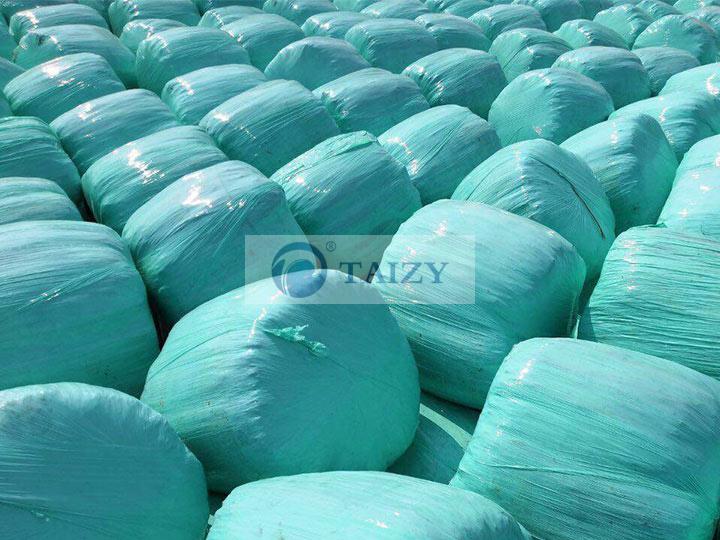
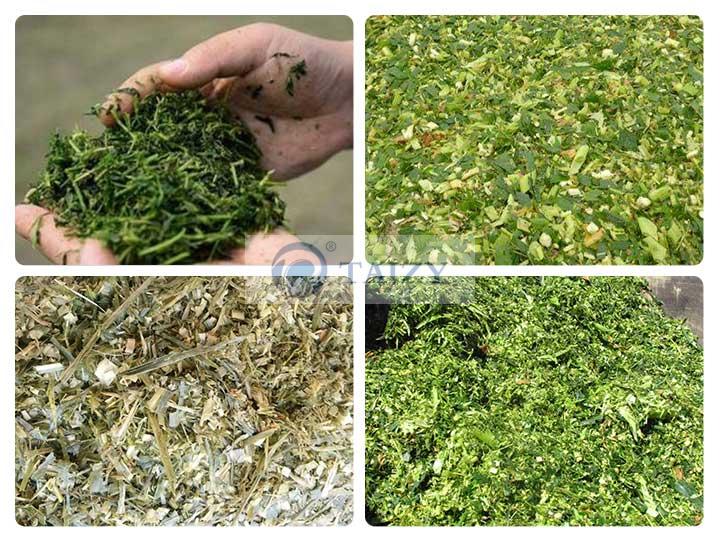
Use a Coupe-paille or a straw harvester to crush or harvest fresh crop products and by-products that contain a certain amount of sugar, such as corn stalks, wheat stalks, rice straw, sweet potato seedlings, and forage grass and other raw materials. The raw material is cut into lengths of 2-4 cm. It can be longer for those with more water content and softer, and shorter for those with less water content and harder. Various raw materials can be mixed and formulated, and the moisture content is preferably 55-70%. The prepared raw materials can be sealed, fermented, and permanently silaged by using a silage baling machine. Mature silage is green to dark green in color, soft and moist, and can be stored for about one year.
Le processus d'ensilage
There must be two processes from green pasture or straw to silage. One is the cutting or crushing of raw materials, and the other is the silage wrap. According to the livestock you raised, you can crush pasture, corn stalks, or other straw into different degrees, such as segments and kneading. After that, the crushed green feed is bundled, wrapped, and fermented by using a machine à balle de silage. The suitable temperature during the silage process is 20°C, and the highest temperature should not exceed 37°C. The temperature is generally controlled at 35°C. It is best not to exceed 30°C. Generally speaking, the total number of microorganisms reaches the highest peak during 5-7 days of fermentation, and lactic acid bacteria are the main ones. Normal silage fermentation generally takes 17 to 21 days.
Types d'ensilage
L'ensilage actuel comprend l'ensilage d'herbe, l'ensilage de maïs, l'ensilage de paille de riz, etc. Selon la méthode d'ensilage, il existe les types suivants d'ensilage
Ensilage général : les matières premières sont coupées, compactées et scellées pour faire multiplier les bactéries lactiques dans un environnement anaérobie, transformant ainsi l'amidon et le sucre soluble dans la nourriture en acide lactique. Lorsque l'acide lactique atteint une certaine concentration, il inhibe la croissance des bactéries de décomposition et préserve les nutriments de l'aliment vert.
Ensilage semi-séché (ensilage à faible humidité) : La faible teneur en humidité des matières premières rend les micro-organismes dans un état physiologiquement sec, et leur croissance et reproduction sont inhibées. Les micro-organismes dans la nourriture fermentent faiblement, et les nutriments ne sont pas décomposés, afin d'atteindre le but de préserver les nutriments. En raison de la faible teneur en humidité de ce type d'ensilage, les autres conditions ne sont pas strictes, donc par rapport à l'ensilage général, une gamme plus large de matières premières peut être utilisée.
Ensilage additif : Certains additifs sont ajoutés pour influencer la fermentation de l'ensilage. Comme l'ajout de divers glucides solubles, l'inoculation de bactéries lactiques, l'ajout de préparations enzymatiques, etc., ce qui peut favoriser la fermentation lactique, produire rapidement une grande quantité d'acide lactique, de sorte que le pH atteindra rapidement le niveau requis (3,8-4,2) ; ou ajouter diverses acides, agents antibactériens, etc. Cela peut inhiber la croissance des bactéries de décomposition et d'autres micro-organismes qui ne sont pas favorables à l'ensilage. Cela peut améliorer l'effet de l'ensilage et élargir la gamme de matières premières pour l'ensilage.
Le principe de l'ensilage
Le principe de la fermentation lactique
Silage is a kind of rough feed obtained by cutting green feed with a moisture content of 65%-75%, and under airtight anoxic conditions through the fermentation of anaerobic lactic acid bacteria to inhibit the reproduction of various bacteria. Fresh pasture and forage crops are cut by using a chuff cutter machine or a corn silage harvester machine and then wrapped the film with a Ensileuse and wrapper machine to allow the fresh pasture to ferment in an air-isolated environment. The plant cells can still perform respiration and deplete the residual oxygen in the silage material in the membrane, causing anaerobic conditions and promoting the reproduction of lactic acid bacteria. Through the anaerobic acidification process, the carbohydrates (mainly sugars ) in the silage raw materials are transformed into organic acids mainly composed of lactic acid and accumulated in the silage raw materials. When the organic acid accumulates to 0.65% to 1.30% (good silage can reach 1.5% to 2.0%), or when the pH drops below 4.2 to 4.0, most microorganisms stop reproducing. Due to the continuous accumulation of lactic acid, the acidity increases, and finally the lactic acid bacteria themselves are inhibited and stop moving, so that the feed can be stored for a long time.
Remarque : L'ensilage contient plus d'acides organiques, ce qui a un effet laxatif. Faites progressivement habituer le bétail au goût lors de la première alimentation. Il n'est pas nécessaire de sceller délibérément après chaque utilisation, car la compaction ne peut pas être effectuée à ce moment-là, le scellement avec un tissu plastique forme plutôt un environnement humide et chaud, et la fermentation secondaire est plus grave.
If you have any questions about the silage baler and wrapper machine, chaff cutter machine, and straw harvester machine mentioned in the article, you can refer to our product article.